Unfiltered Yes
Stories of Saying Yes to the Impossible

Over four decades, I’ve learned that the real magic in engineering, startups, and creation isn’t the perfect idea—it’s the “yes” that kicks it off, followed by the art of compromise to make it real. Ideas rarely survive intact, but that’s the beauty: you bob, weave, and pivot until something even better emerges into the world. This serialized memoir is my way of sharing those moments—from tech breakthroughs to creative leaps—hoping it sparks your own. Let’s start at the beginning, with a barefoot meeting that helped birth streaming before it had a name.
Before Streaming Was Streaming
How a barefoot meeting, a dark-fiber prototype, and a lifetime of saying “yes” built the road to now.
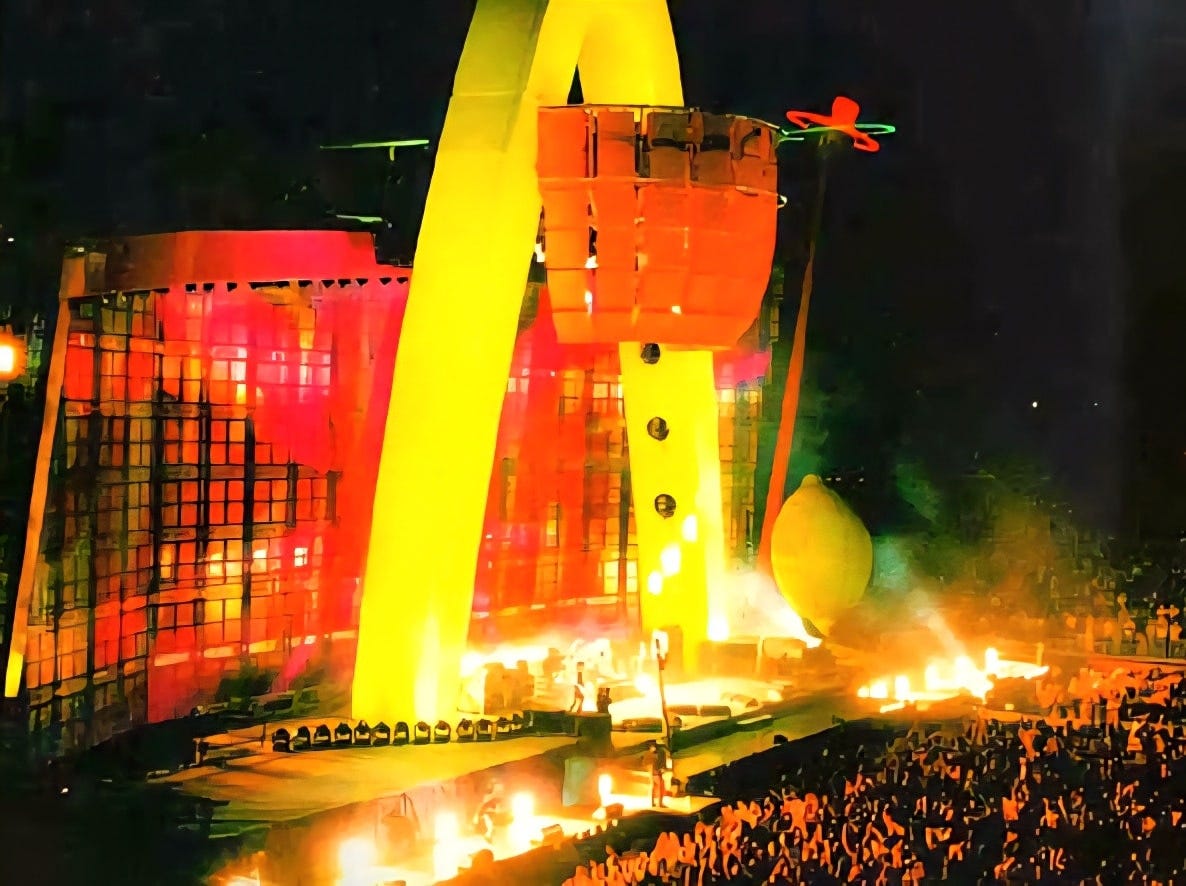
I wasn’t in the room when U2 streamed live to the world.
By then, my part was already complete — the patents I’d written, the architecture drafted, the concept proven.
But when the PopMart concert went out smoothly across the Internet, I sat there in silence.
It was surreal.
The impossible had crossed over into reality — an echo of something that started years earlier on a beige carpet in Arizona.
Long before anyone called it streaming, we were a small team in Scottsdale, trying to make video download faster than real time.
The Floor in Scottsdale
The office was pleasant but ordinary — beige carpet, framed prints, a small kitchenette.
You wouldn’t have known it was about to host a moment of technological audacity.
We didn’t even have schematics yet, only research and instinct suggesting such a machine might be possible.
It was 1990.
We were sitting on the floor.
Richard’s wife was very pregnant; the floor was the only comfortable spot for her.
Across from me sat U2’s business representative, Ozzie Kilkenny, barefoot, brown corduroys, green T-shirt, and that unmistakable Irish lilt.
We already had U2’s investment, but the question that day was whether to spend another $300,000 — roughly $720,000 today — to build a prototype nobody on Earth had ever seen.
After an hour of circling the question, Ozzie leaned forward and asked the line that would define everything after it:
“I just want to know one thing. Can you do it?”
And I said yes.
That single yes has echoed through every decade since.
The Machine That Didn’t Exist Yet
The goal was absurd: download a full-quality video faster than you could watch it.
Compression was primitive. MPEG wasn’t finalized.
The RAM and throughput requirements were astronomical.
So we went looking for magicians.
We found them in a small Silicon Valley garage shop called Finisar — Jerry, Frank and their brilliant team — and asked them to push dark fiber to its absolute limit.
They managed roughly 650 megabits per second across that link — in 1990.
Unheard of.
That single test proved the concept could work. Finisar went on to become a major fiber-optic company because of it.
It was the kind of era when the impossible only looked that way until someone tried.
The CES Launch
Once the prototype worked, there was only one thing left to do: show the world.
We packed it up and took it to CES — the Consumer Electronics Show in Las Vegas.
And the world noticed.
We were on CNN, in Popular Science, and in trade magazines like Radio-Electronics, which described our parent company, then called Explore Technology, as “proposing a pay-per-view system transmitting data in short bursts to a receiver which stores the information and plays it back later.”
For a moment, we were everywhere — a small Arizona outfit making the leap from theory to demonstration.
Looking back, that was when the dream became real.
We’d built something that shouldn’t exist — and there it was on the convention floor, humming quietly under fluorescent lights, turning heads.
Mendocino
Around that same time, we gathered again — this time at Richard’s home in Mendocino, overlooking the Pacific.
We were preparing for a meeting with the executives of Ameritech, one of the Baby Bells.
Just down the road, waves crashed against cliffs. Inside, we were exhausted, exhilarated, and half-terrified.
We’d built a machine that didn’t belong to its decade, and we were about to explain it to the establishment.
It went better than we deserved.
The science held. The possibilities clicked.
For the first time, a major carrier could see what was coming — and we were already standing there, pointing toward it.
The Pattern of My Life
A few years earlier, I’d published my first commercial program, HomeBase, for the Commodore 64 — a flat-file database I built before I fully understood databases.
There were hardly any software publishers then, but I found one.
It sold.
It was 1986, and I was too busy building to realize I’d just entered history.
That’s been my pattern ever since: I never notice the magnitude of a moment while I’m in it.
It always feels like the next logical thing.
The Long Echo
At Burst.com, my first major contribution was helping write a patent — the one that would later underpin a $60 million settlement with Microsoft Corporation.
And right after we filed it?
I taught myself patent law, sat for the U.S. Patent Bar, and passed on the first try.
Because that’s what I do: learn the system, then master it.
By the mid-1990s, others had taken the torch.
The code I didn’t write was written.
The patents I’d drafted became part of the backbone of modern streaming.
And then, one night, U2’s Lemon went live — the PopMart Live from Mexico City webcast that used Burst.com’s streaming technology — and everything we’d imagined in Scottsdale rippled across the planet.
When the Microsoft case finally settled, it wasn’t revenge — it was confirmation.
The future had unfolded exactly where we’d aimed it.
After the Burst
You’d think that would be enough — to help push the world into the streaming age — but curiosity doesn’t retire.
It just changes tools.
After that chapter, I joined Honeywell, leading software teams for the International Space Station.
Eighty engineers, mission-critical code, lives depending on every line.
A different kind of intensity — less caffeine, more precision — but the same heartbeat: build something that works because it has to.
And when that era ended, I built something entirely different: a home recording studio.
Not glamorous — no hardwood floors, just a room packed with state-of-the-art gear.
We began recording there, then moved the sessions to a professional studio with a Grammy-winning producer.
Because of course.
Whether it’s software or songs, the urge is the same: make something real.
Then came fifteen years in SaaS — a string of startups, some failures, some exits, one six-figure, one seven-figure.
Every venture a new echo of that same moment on the carpet when Ozzie asked if it could be done.
And every time, the answer was yes.
The Present Thread
Now I’m building again — this time as cofounder of Jade AI, a platform for creative intelligence, where artists and filmmakers use generative tools to bring ideas to life.
It feels familiar — that same edge where nobody can quite see what comes next.
And in 2020, out of nowhere, I also became an oil painter.
No training, no mentor — just a sudden decision that I wanted to try.
So naturally, I started with the hardest form: portraits and realism.
Because of course.
Five years later, I’m a pretty formidable painter. The brushes and canvases are just new circuitry — light, color, problem-solving, creation.
The tools change, but the impulse doesn’t.
Curiosity. Creativity. The quiet thrill of turning maybe into working.
Looking Back
When I think about that barefoot meeting in Scottsdale — a pregnant founder’s wife on the carpet, a question hanging in the air — I realize it wasn’t just the start of a company.
It was the start of a lifetime pattern.
People ask if something can be done.
I pause.
And I say yes.
Then I figure out how to make it real.
Coming Next
The Circular File (1982 – 1983) — a Commodore, a desk, and the first spark of entrepreneurship.
About the author
Earl Mincer is an engineer, artist, and co-founder of Jade AI. Over four decades he’s helped pioneer digital video, build software for the International Space Station, record music with Grammy-winning producers, create award-level oil paintings, and launch multiple SaaS startups. This the first chapter in Unfiltered Yes — a serialized memoir of invention, curiosity, and the quiet art of building things that shouldn’t exist.